GF312D Portable Energy Meter Test Equipment
The GF312D is a handheld three phase standard reference meter for calibrating three-phase and single-phase energy meter errors, for both static and electromechanical meters. The manufacturer's datasheet describes it as a portable meter test instrument with a 6-inch TFT colour display, 24 keys, a PC interface and stored test results.
Its datasheet accuracy classes are 0.05%, 0.1% and 0.2%, with a high-accuracy 0.05 mode for direct current up to 20A and a clamp-on CT mode better than 0.2 class. Flexible current probes cover 2000A and 3000A. These are the manufacturer's own datasheet figures, stated here as the manufacturer's figures, not as independently verified measurements.
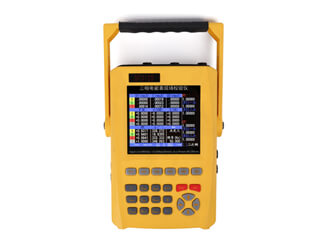
Item and specification
| Use | Three-phase and single-phase energy meter error calibration |
|---|---|
| Accuracy class | 0.05% / 0.1% / 0.2% (datasheet) |
| Direct current | 1mA to 20A (0.05 mode to 20A) |
| Clamp CT current | 10mA to 3000A; optional clamps 5A to 3000A |
| Test voltage | 0 to 480V |
| Harmonics | 2nd to 63rd |
| Phase angle | 0 to 360 degrees, 0.01 degree resolution |
| Frequency | 45 to 65Hz |
| Data storage | 500 sets |
| Interface | RS232 / USB |
| Size and weight | 220 x 138 x 61mm, 1.7kg; carry case 450 x 320 x 185mm, 8.5kg |
| Ambient | -10C to 55C |
How to select
A buyer choosing the GF312D should check first whether the meters under test are three-phase or single-phase, and whether direct connection or clamp-on measurement is needed. Direct connection suits meters that can be taken out of circuit; clamp-on CTs suit on-site checks where the meter stays in service. Check also whether the harmonic range and the phase-angle resolution match the test standard you must meet.
Ask for the current datasheet to be confirmed in writing before ordering, because datasheets are marked subject to change without notice. Before payment, confirm the model, the accuracy class, the current probe range if clamps are needed, the quantity, and the delivery terms.
Records and comparisons
Keep a record for every test this instrument performs. A useful record states the instrument model, the device under test, the test settings, the results, the date, and the person who ran the test. Records of that form can be checked months later, when a result is questioned or a device is retested after repair. A record that only says pass or fail cannot be checked, and a test that cannot be checked will eventually have to be repeated.
When comparing this model with a neighbouring model from the same family, compare the same items for both: the test functions, the ranges, the accuracy class, the display and output features, and the standards referenced. A comparison that uses one model's headline figures against another model's detailed figures is not a comparison. Ask for the current datasheet for each model under consideration, and compare datasheet against datasheet.
If the instrument will be used by more than one person, agree who owns the test records and where they are kept before the first test. Shared instruments with private records produce results that cannot be checked by anyone except the person who ran the test, which defeats the purpose of keeping records at all.
What to confirm before ordering
Before payment, confirm the model, the specification from the current datasheet, the quantity, the price, the lead time, and the delivery terms, in writing. Ask in your inquiry to confirm the payment terms, the trade terms, and the reply time you should expect, rather than assuming any of them. No price, minimum order or lead time figure is stated on this site.
Notes
This page states no warranty period, no price, no minimum order and no lead time figure, because the reference material behind this site does not give a company-site figure for them. Confirm each of those in writing with your inquiry.
Figures on this page come from the manufacturer's own category pages, manufacturer-hosted datasheets, or a shop listing stated as such. Where the reference material does not settle a figure, this site states that it is unresolved and publishes no figure, rather than choosing one.
Send an inquiry: include the model, the test or measurement requirement, and the quantity you need. Before payment, confirm the model, the specification from the current datasheet, the quantity, and the delivery terms.