How to Choose a CT PT Analyzer for Metering and Protection Testing
Choosing a CT PT analyzer starts with a list, not a catalogue. Write down the transformer types you must test, the tests you must run, and the accuracy the results must support, before looking at any model. An analyzer that covers everything costs more than one that covers your list, and an analyzer that misses one required test cannot be fixed by using it carefully.
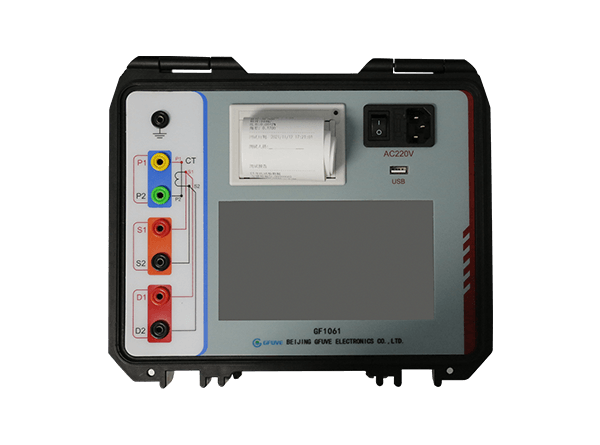
The transformer types come first. Current transformers, voltage transformers and capacitor voltage transformers are different test objects, and not every analyzer covers all three. In the manufacturer's range, the GF1061 covers CT, PT and TYP class CT, while the GF1061CT covers CT only, the GF1061PT covers PT only, and the GF1061CVT covers CVT. The GF106 and GF106T cover CT and PT testing, and the GF1060 family covers laboratory CT testing with comparator functions. If your work is CT only, a combined analyzer adds capability you will not use; if your work includes PT or CVT, a CT-only analyzer is the wrong purchase, however good its CT results are.
The tests come second. Ratio, polarity, burden, excitation, phase error and DC resistance are the usual list, but not every job needs all of them, and not every analyzer lists all of them. The GF1061CT lists burden, polarity, excitation, phase error, DC resistance and ratio testing from 1 to 50000. The GF106 lists ratio and phase error testing with a 3000-group data logger. The GF1061PT lists PT phase error, ratio and testing of various PT types in one minute. Compare the test list model by model against your list, and treat a missing test as a missing capability, not as a test you can work around.
Ratio range comes third, and it is where a purchase most often goes wrong. A ratio range that covers your largest transformer but not your smallest, or the reverse, leaves part of your work untestable. The GF1061CT range to 50000, the GF106 CT range to 30000 and PT range to 10000, and the GF1061PT category-page range of 1 to 30000 with class 0.05 are all stated on the manufacturer's category pages. Note carefully that a different document in the reference material gives different figures for the GF1061PT; this site uses the category-page figures only and does not merge the other document's figures, and a buyer should ask for the current datasheet to be confirmed in writing before ordering rather than assuming either document is current.
Accuracy class comes fourth. The class must match the class of the transformers under test and the standard the test must meet. The GF106 lists accuracy 0.05% or 0.1%; the GF1060 lists class 0.05 with a 0.02s standard CT; the GF1061PT category page lists class 0.05. An analyzer less accurate than the transformer class it tests cannot prove that class; it can only suggest it. Ask for the accuracy that applies to the tests you will run, not a headline accuracy that applies to a different test.
Practical features come fifth, and they matter more in the field than in the laboratory. A mini printer for field printing, USB download or PC control, a touch display that works with gloves, weight for carrying, and data storage capacity all affect whether the analyzer gets used or stays in the laboratory. The GF1061 lists a 7-inch touch display, a mini printer, USB and RS232 control; the GF106 lists a 3000-group data logger. Check these against how the analyzer will actually be carried, powered and read on site.
Standards come sixth, as references, not as claims. The manufacturer's category pages reference IEEE C57.13, IEC 60044 and IEC 61869 for CT and PT testing. A reference to a standard means the test method follows that standard's approach; it does not mean the analyzer itself is certified to that standard, and no certification claim is made here. If a contract requires a certified instrument, ask for the certificate, with its number and scope, before ordering.
Finally, write the inquiry as a specification, not a model name alone. List the transformer types, the tests, the ratio range, the accuracy class, the display and output features, and the standards the work must follow, and ask for the datasheet for the model offered to be confirmed in writing. Before payment, confirm the model, the test functions, the ratio range, the quantity, and the delivery terms. A model name without a test list is an order waiting to be wrong.
One more check belongs in any analyzer purchase: how the analyzer itself will be verified. An analyzer is a measuring instrument, and its results are only as good as its own calibration state. Ask what verification the supplier recommends, how often it should be done, and what reference it is checked against. Keep the verification record with the test records the analyzer produces, so that a result can be traced back to a verified instrument. An analyzer whose own verification is unknown cannot settle a dispute about a transformer, because the dispute will simply move from the transformer to the analyzer. A purchase that includes a verification plan, with dates and references, should have its verification plan, fees, and acceptance criteria confirmed before ordering. The verification record supports traceability and evaluation of results, but it does not guarantee that a result will be accepted as valid in a dispute — during a commissioning dispute, a warranty discussion, or a protection investigation where two parties disagree about what a transformer actually did.
A final practical point: buy the accessories with the analyzer, not after it. Leads, clamps, test cables and software licences ordered later arrive later, and the first job is often the one that needs them most. List the accessories each test on your list requires, check them against what is included with the model offered, and order the difference with the analyzer. An analyzer delivered without the lead its first test needs is an analyzer that cannot be used on arrival, however good its specification looks on paper.
Figures on this page come from the manufacturer's own category pages, manufacturer-hosted datasheets, or a shop listing stated as such. Where the reference material does not settle a figure, this site states that it is unresolved and publishes no figure, rather than choosing one.
What to confirm before ordering
Before payment, confirm the model, the specification from the current datasheet, the quantity, the price, the lead time, and the delivery terms, in writing. Ask in your inquiry to confirm the payment terms, the trade terms, and the reply time you should expect, rather than assuming any of them. No price, minimum order or lead time figure is stated on this site.
Send an inquiry: include the model, the test or measurement requirement, and the quantity you need. Before payment, confirm the model, the specification from the current datasheet, the quantity, and the delivery terms.