What to Check Before Ordering a Split Core CT
A split core current transformer looks simple: a core that opens, a conductor through it, a secondary output. Most ordering mistakes come from the same simplicity, because the four numbers that decide whether it works — window size, ratio, accuracy and output — are easy to get one of wrong while the other three are right.
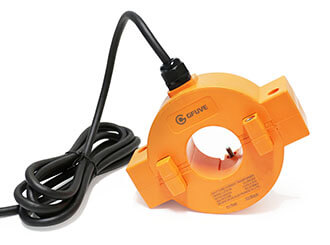
Window size comes first, because it is the one mistake that cannot be fixed after delivery. Measure the conductor, cable or busbar the core must close around, including insulation and any bundle, and compare it with the core opening. The manufacturer's range covers small indoor cores such as the FU-32 with a 32mm jaw, through 55mm outdoor cores such as the LZCK-55, to large busbar cores such as the FU160 with a 160 by 80mm maximum. A core that does not close properly does not measure properly, whatever its ratio and accuracy say on paper.
Ratio comes second. The ratio must match the meter, relay or monitor input it feeds, and the primary current range must cover both the normal load and the highest current to be measured. The FU-32 shop listing gives nominal primaries from 100A to 600A with ratios 400:5 or 200:5, customizable; the LZCK families cover ranges from tens of amps to thousands of amps depending on the model. A ratio chosen from the normal load alone will saturate or read low at peak load; a ratio chosen from peak load alone will read poorly at normal load. Check both ends.
Accuracy class comes third, and it depends on the use. Metering needs a metering class; protection needs a protection class; a transformer that is accurate for one is not automatically accurate for the other. The manufacturer's category pages list classes such as 0.5s, 0.5, 0.2s and 1 across the split core families, with the class varying by model. Ask which class applies to the model and ratio you need, and confirm it from the datasheet in writing, because class can vary with ratio within one model family.
Output type comes fourth. Split core CTs in this range offer 5A and 1A secondary current outputs, and millivolt and voltage outputs such as 333mV, 1V and 100mV to 2V, depending on the model. The output must match the input of the meter or monitor it feeds: a current output into a voltage input, or the reverse, gives a reading that looks plausible and is wrong. Check the input type of the receiving device before ordering, not after installation.
Standards come fifth, as design references. The manufacturer's category pages reference IEC 60044-1, IEC 61869-2 and ANSI/IEEE C57.13 for split core models. Those references describe the design and test approach; they are not, by themselves, a certificate for the unit supplied, and no certificate claim is made here. If a contract requires a certified unit, ask for the certificate with its number and scope before ordering.
One thing this checklist deliberately does not do is state a protection rating for models where the reference material does not settle it. Ratings given in different places for the same model differ, and a rating copied from the wrong place is worse than no rating, because it will be relied on for an outdoor or high-voltage installation. Ask for the rating that applies to the model you need to be confirmed in writing from the current datasheet, and do not accept a rating quoted from a listing alone.
Finally, the inquiry itself. Send the conductor size, the primary current range, the required accuracy class and use (metering or protection), the output type the receiving device needs, the system voltage, and the quantity. Before payment, confirm the model, the window size, the ratio, the accuracy class, the output, the quantity, and the delivery terms. A split core CT ordered on model name alone, without those six items, is an order waiting to be returned.
Installation mistakes deserve their own paragraph, because installation mistakes are one possible cause of split core CT problems found in service. The common ones are a core that is not fully closed, because dirt or a cable tie holds the two halves apart; a burden that does not match the transformer's rated burden, so the accuracy class does not apply; a reversed secondary connection, so metering reads backwards or differential protection sees a false fault; and a secondary circuit left open, which is a safety hazard as well as a measurement error. Each of these is cheap to prevent and expensive to find later, because the symptom looks like a faulty transformer, a faulty meter, or a faulty relay, and the investigation starts in the wrong place. A short installation checklist — core closed and clean, burden checked, polarity checked, secondary never open, ratio and class recorded — can help catch these four before the circuit is energized. Include that checklist in the work instruction for the installation, not only in the purchase order, because the person installing the transformer is rarely the person who ordered it. Keep the completed checklist with the test record for the installation, so that a later fault investigation can check installation causes first, though a completed checklist cannot rule out every installation cause.
One more ordering detail is often missed: the burden. A current transformer is specified with a rated burden, and its accuracy class applies at that burden. A burden far below or above the rated value changes the accuracy, sometimes sharply. Check the burden of the meter, relay or monitor the transformer will feed, including wiring resistance, and compare it with the rated burden for the model and ratio. If the burden does not match, ask whether another ratio or model fits, rather than accepting an accuracy class that does not apply to your circuit.
Figures on this page come from the manufacturer's own category pages, manufacturer-hosted datasheets, or a shop listing stated as such. Where the reference material does not settle a figure, this site states that it is unresolved and publishes no figure, rather than choosing one.
What to confirm before ordering
Before payment, confirm the model, the specification from the current datasheet, the quantity, the price, the lead time, and the delivery terms, in writing. Ask in your inquiry to confirm the payment terms, the trade terms, and the reply time you should expect, rather than assuming any of them. No price, minimum order or lead time figure is stated on this site.
Send an inquiry: include the model, the test or measurement requirement, and the quantity you need. Before payment, confirm the model, the specification from the current datasheet, the quantity, and the delivery terms.